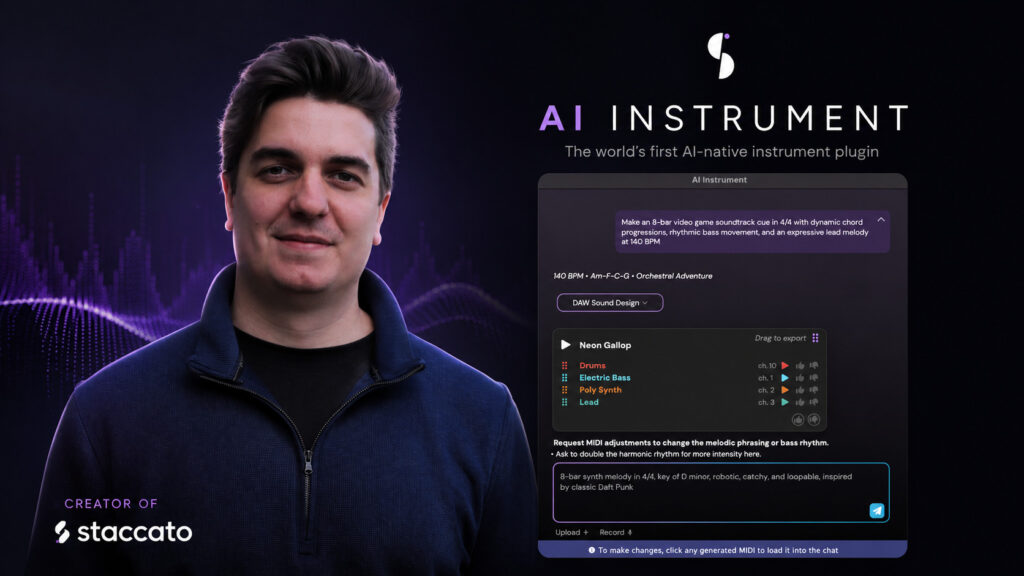
Jeff Lupker is the co-founder and CEO of Staccato, the AI MIDI generation plugin that won AudioPlugin.Deals’ 2026 Plugin of the Year award. He completed his PhD at Western University Don Wright Faculty of Music, where the original idea for Staccato first surfaced while he was writing a string quartet for his thesis.
Jeff is also the guitarist for America’s Got Talent Golden Buzzer Winner Stacey Kay. We caught up with Jeff to talk about why Staccato took a different path than most AI music companies, when the lifetime license is going away, and what he thinks a lot of AI music tools still miss.
Let’s start with the APD deal, because by the time some readers find this, it might be gone. You’re offering Staccato lifetime for $89.99, which is 70% off the normal $299.99 price. Why such an aggressive number?
We wanted to get Staccato in front of more serious producers, and APD has the right audience for that. We picked a price that would get people who’d been curious about it to finally jump in. But this is the last time we’re doing a deal like this. The promo runs through the end of May, and later this year we’re planning to retire lifetime pricing completely.
Unlike a traditional plugin, every time someone uses Staccato it still requires AI processing on our side, which creates ongoing costs for us over time. At a certain point, the economics stop making sense. If someone has been waiting to try it, this is probably the best chance they’re going to get.

Take us back to where Staccato started. You were writing a string quartet?

Yeah, this was back in 2021 at Western. The piece was for my PhD thesis, and I was juggling gigs at the same time trying to pay the bills. I got stuck on one section for a while. I knew the direction I wanted to go musically, but I didn’t have the time to sit there for days experimenting until something clicked.
That got me thinking about a tool that could generate editable MIDI ideas instead of finished audio. One of the biggest problems with a lot of current AI music tools is that once they generate something, you’re kind of boxed in by it. With MIDI, you still have control. You can change the harmony, swap instruments, move notes around, reshape the whole thing into your own style. That became the core idea behind Staccato.
A lot of AI music companies generate finished audio. You went the MIDI route. Why?
Because that’s how producers actually work. Inside a DAW you’re editing notes, changing instruments, adjusting timing and velocity, moving things around. MIDI stays flexible in a way audio doesn’t.
There’s also an environmental side to it that people don’t really talk about enough. MIDI files are incredibly lightweight compared to audio. A full multi-track MIDI song might only be a few dozen kilobytes, while the same thing in high-quality audio can be thousands of times larger. A lot of AI audio companies are running massive amounts of compute and energy just to process and generate huge audio files at scale.
By focusing on MIDI, our environmental footprint is dramatically smaller. We can build something powerful without needing the same level of compute infrastructure that a lot of AI audio generation depends on.
Another huge difference is creative control. With Staccato, the model can actually understand detailed prompts — key, BPM, genre references, exact bars you want changed, arrangement ideas, timing changes, all of it.
The AI audio generators don’t work that way. They tend to grab a few keywords from your prompt and generate an entire song around them. Sometimes you get something cool, sometimes you don’t. It can feel more like rolling dice than actually creating music. We wanted Staccato to feel more like a creative companion where the musician stays involved in the process the whole way through.
You’ve been public about training only on open-source, pre-publication, and original MIDI. That’s a different stance than most of the industry.
It is, and for me that’s important philosophically. We don’t scrape copyrighted songs from Spotify or Apple Music. The model is trained on MIDI that’s either public domain, properly cleared, or created internally by our team.
A lot of musicians are understandably uneasy about AI companies training on copyrighted recordings without permission. I get that. If you’re building tools for musicians, you should respect the people making the music in the first place.
The interesting thing is we’ve actually found that this approach gives us better musical results too. Most AI music systems trained on huge libraries of mainstream songs tend to generate music that sounds like a blend of everything that’s already out there. Because Staccato is built much more around music theory, structure, emotional movement, and composition itself, the output tends to feel more intentional and original.
You’re a composer and a guitarist. How does that show up in the product?
I play guitar and keys, and I’ve spent a lot of time in both classical music and rock music. Led Zeppelin is probably my favorite band. Lately my co-founder Jason and I have also been listening to Angine de Poitrine a lot. They’re Canadian too, like us, and if people haven’t checked them out already they absolutely should.

At the end of the day, I think people still want to feel a human connection in music. AI can help unlock ideas faster, but artists still want creative input and ownership over what they’re making. The best moments in music usually come from personal choices, weird instincts, mistakes, emotions. Things that feel human.
That perspective shapes Staccato pretty heavily. The goal is to give people more ideas, more momentum, and more ways into a song while still letting them steer where it goes.
Where do you see AI music going over the next couple of years?
I think we’ll start seeing more companies move beyond the current approach of just scaling data and compute endlessly. A lot of those systems end up sounding like this blurry mix of everything that’s already existed because they’re trained heavily on the same mainstream material over and over again.
What makes Staccato different is that it was trained more around how music actually works, and over time, it will also learn your style. The more you use it, the more it starts responding to the kinds of choices you gravitate toward.
To me, that’s the more interesting direction for AI music overall. Not just generating random songs instantly but building systems that actually understand musicality and adapt to individual creators. That’s exactly what we’re focused on right now, and it’s a big part of what future Staccato updates are going to keep pushing toward for everyone coming in through the APD deal.
Last one. What has surprised you most since launching Staccato?
The range of people using it. We already know Staccato is being used in music for several TV shows that we can’t publicly name yet, and it’s also being used by multi-platinum producers connected to artists like The Weeknd, Paul McCartney, and Drake. Seeing people at that level use it has been amazing.
But what surprised us even more has been hearing from everyday musicians. Since the APD deal launched, we’ve had a lot of users reach out saying Staccato feels like the best co-producer they’ve ever had. A lot of musicians today don’t necessarily have access to a network of elite collaborators around them. They might be making music alone in their bedroom, but they still want tools that help them work at a really high creative level.
The age range has been wild too. We have people using it who are 18 years old, and others in their 70s and 80s. AI has made music technology feel approachable in a way older software sometimes didn’t. You can just talk to it. You can explain a feeling, describe what you want musically, and start creating from there. That’s been one of the coolest parts to watch.